Who Created the HEIC File Format? The Full Story
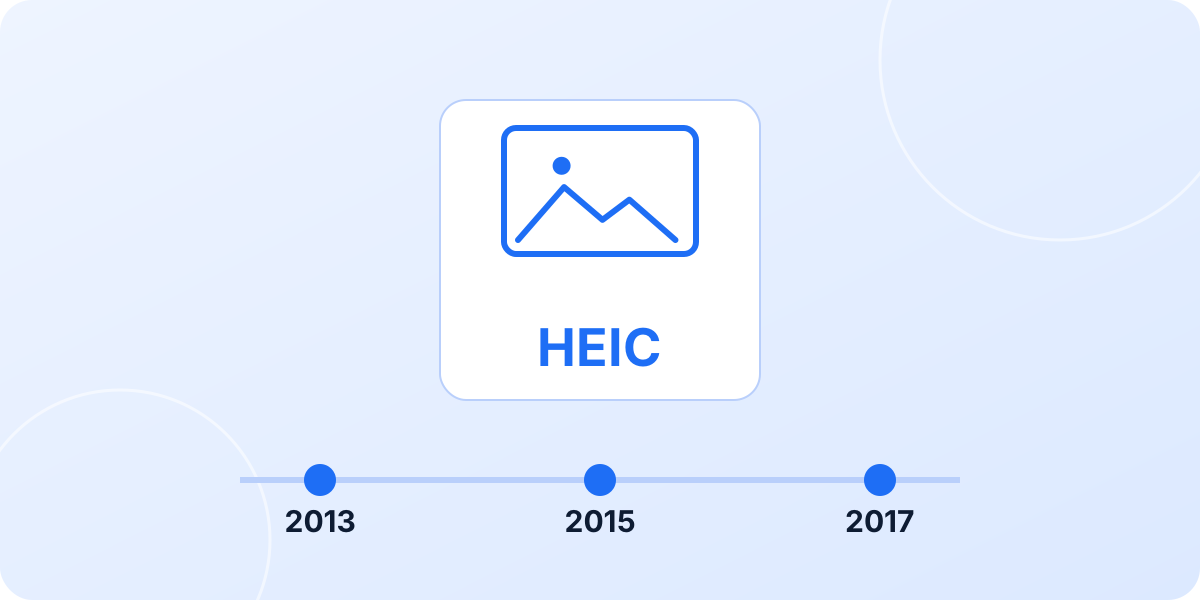
Ask ten people who created the HEIC file format and nine will say Apple. It is a reasonable guess, since iPhones made the format famous, but it is wrong. HEIC was designed by an international standards committee, with a Finnish phone maker doing much of the heavy lifting, and it was finished two full years before Apple shipped it. This is the story of who actually built the format sitting behind every modern iPhone photo.
If you want a primer on the format itself before the history lesson, start with our explainer on what a HEIC file is. Here we focus on the people and organizations behind it.
HEIC was created by MPEG, the Moving Picture Experts Group, a working group of the ISO and IEC standards bodies. The specification was finalized in mid 2015 as ISO/IEC 23008 part 12, with Nokia Technologies as a key contributor and the author of the reference implementation. Apple did not invent it; Apple adopted it in 2017 and made it the iPhone's default.
No, Apple did not invent HEIC
Let's clear up the myth first. Apple announced HEIF/HEIC support at WWDC in June 2017 and shipped it that September in iOS 11 and macOS High Sierra, making HEIC the default camera format on compatible iPhones. Overnight, a format almost nobody had heard of became the output of one of the most widely used cameras on the planet.
That was adoption, not invention. By June 2017 the standard had been sitting finished for two years. What Apple contributed was distribution and timing: hardware HEVC encoding needs modern silicon, roughly the iPhone 7 generation of chips or newer, and by 2017 enough of the installed base qualified. Apple bet that halving the storage cost of every photo was worth years of "why won't my photo open" complaints. Judged by the fact that HEIC is still the iPhone default nearly a decade later, the bet paid off.
Apple also never locked users in. To this day, an iPhone can be switched back to JPG under Settings > Camera > Formats by choosing "Most Compatible" instead of "High Efficiency", and Settings > Photos offers an "Automatic" transfer mode that converts photos to JPG when copying to a Mac or PC over USB. Those escape hatches exist precisely because Apple knew it was pushing a format the rest of the world had not caught up with.
Crediting Apple with HEIC is like crediting the biggest radio station with writing the song. The writers were elsewhere.
Meet MPEG, the group that actually created it
HEIC's real author is MPEG, the Moving Picture Experts Group: a working group operating under ISO and IEC, the international standards organizations. If the name sounds familiar, it should. MPEG is the group behind the MP3 audio format, the MP4 container and the HEVC video codec. A large share of all the media any device plays passes through formats this committee defined.
In 2013, MPEG defined the requirements for a modern image format: one file that could hold multiple images, rich metadata, transparency and the latest compression technology. Work proceeded through the usual standards machinery of proposals, drafts and ballots, and the technical specification was finalized in mid 2015 as ISO/IEC 23008 part 12, formally known as "MPEG H Part 12", and informally as HEIF, the High Efficiency Image File Format.
HEIC is the branded flavor of that standard: a HEIF file whose images are compressed with the HEVC codec. When your iPhone saves a .heic file, it is executing a design decision made in an ISO committee room, not in Cupertino.
Nokia's role: the engineers behind the standard
Standards committees do not write code; companies do, and the company that mattered most for HEIF was Nokia Technologies. Nokia was a key developer of the specification and a major contributor to it, and it published the reference implementation of HEIF, the canonical codebase other developers build against, openly on GitHub (github.com/nokiatech/heif).
Nokia also made an unusually friendly licensing move: it licenses its HEIF patents royalty free for noncommercial use. That decision lowered the barrier for researchers, hobbyists and open source projects to experiment with the format years before any phone shipped it by default.
Nokia's generosity covers the container, not the compression inside it. HEVC decoding carries patent royalties collected by pools such as Access Advance and Via LA (the successor of MPEG LA), which is why Chrome, Firefox and Edge never added HEIC support and why Microsoft charges about $0.99 for its HEVC extension on Windows 10. Most HEIC headaches trace back to patent economics, not technology.
Before we dig into the compression layer, here is the whole ownership question settled in a single picture.
Where the compression came from: HEVC
The codec doing the actual pixel squeezing has its own parentage. HEVC, also known as H.265, was standardized in 2013 by JCT VC, the Joint Collaborative Team on Video Coding: a partnership between MPEG and VCEG, the video experts group of the ITU, the UN's telecommunications standards agency. Two rival standards families pooled their best engineers to build a codec efficient enough for 4K video.
HEIF's designers made a pragmatic call: instead of inventing yet another still image codec, reuse the best video compression available and apply it to single frames. That is why a HEIC photo is, at heart, one HEVC compressed video frame in an image wrapper, and why it beats JPG so decisively on file size.
Why create a new format at all?
By the early 2010s, JPEG was showing its age everywhere. Published in 1992 by the Joint Photographic Experts Group, it compresses with a technique called the discrete cosine transform, stores exactly one image per file, caps color at 8 bits per channel, has no transparency, and loses a little quality every time it is saved again. None of that could be fixed without breaking the one thing JPEG had going for it: universal support on every device, browser, printer and web form built since the 1990s.
Meanwhile smartphones had turned everyone into a photographer with a storage problem. Photo resolutions climbed, burst shooting and Live Photos multiplied the frames per shot, and cloud backends were paying for every redundant byte. MPEG's answer attacked both fronts at once: HEVC compression delivered files typically 40 to 50 percent smaller than JPG at the same visual quality, and the flexible container added the features 1992 could never have imagined, including bursts and sequences in one file, depth maps, alpha transparency, up to 16 bit color with HDR, and nondestructive edits stored as instructions.
The timeline at a glance
| When | What happened |
|---|---|
| 2001 | The ISO Base Media File Format (ISO/IEC 14496 part 12) is published; HEIF later reuses this container blueprint. |
| 2013 | MPEG sets the requirements for the new image format; JCT VC finishes the HEVC (H.265) codec the same year. |
| Mid 2015 | ISO/IEC 23008 part 12 is finalized: HEIF officially exists, with Nokia's reference implementation alongside it. |
| June 2017 | Apple announces adoption at WWDC. |
| September 2017 | iOS 11 and macOS High Sierra ship; HEIC becomes the iPhone camera default. |
| 2018 to 2019 | Android 9 learns to display HEIF images, and Android 10 lets capable phones capture HEIC. |
| 2020s | Canon, Sony, Nikon, Fujifilm and Hasselblad cameras add HEIF capture for 10 bit HDR stills. |
| 2023 | Safari 17 starts displaying HEIC images in web pages. |
| 2026 | A W3C meeting agrees to set up a community group to bring HEIF to more browsers. |
The HEIF container is a special case of the same ISO Base Media File Format that underlies MP4, first defined back in 2001. Structurally, a HEIC photo and an MP4 movie are cousins: the same system of nested data boxes, one arranged for still images, the other for video. MPEG did not build HEIC from scratch; it remixed twenty years of its own container engineering.
Here is the same story laid out year by year, from the first container specification to today's cameras.
What happened after Apple adopted it
Apple's 2017 move turned a dormant standard into an ecosystem. Android had shipped read support for HEIF in Android 9 (2018), and Android 10 (2019) added HEIC support on capable hardware. Samsung put a HEIF capture option in Galaxy phones from the S10 onward, with other makers such as Xiaomi (Xiaomi 12) and OPPO (Reno 7) following.
Then the camera industry arrived. Canon's EOS-1D X Mark III and EOS R5, R6 and R8, Sony's a1 and a7 IV, Fujifilm's X-H2S, X-H2, X-T5 and X100VI, Nikon's Z9 and Z8, and Hasselblad's X2D all shoot HEIF, typically as 10 bit HDR stills that JPG simply cannot represent. For the full map of which devices, apps and platforms speak the format today, see our overview of where HEIC is used.
Desktop software followed at its own pace. GIMP has been able to read and export HEIC since version 2.10.2 in May 2018, while Photoshop reads the files but still cannot save them. Microsoft split the difference on Windows: Windows 10 needs Store extensions, including an HEVC extension that typically costs about $0.99, while Windows 11 usually comes with the HEIF extension preinstalled. And the patent friction that kept HEIC out of browsers pushed the industry toward royalty free successors: AVIF, built on the AV1 codec, and JPEG XL were designed to deliver the same ideas without the licensing bill, and iOS 16 and later can already display AVIF.
What never arrived is universal support for HEIC itself. As of mid 2026, Safari remains the only major browser that displays it, and plenty of web forms and marketplaces still reject the files outright. That gap between where HEIC is created and where it is accepted is exactly why a free HEIC to JPG converter still earns its keep: the format won the camera, but JPG still owns the web. Ours converts at full resolution with Exif metadata preserved, starts automatically on upload, and hands back a batch of photos as a single ZIP.
The credits, properly assigned
So who created the HEIC file format? MPEG wrote the standard and finalized it in mid 2015. Nokia Technologies did much of the engineering and published the reference implementation. JCT VC, the joint MPEG and ITU VCEG team, supplied the HEVC compression in 2013. And Apple, in 2017, did what only Apple could: it put the whole thing in a billion pockets and made the rest of the industry react.
Frequently asked questions
Did Apple invent HEIC?
No. The HEIF standard was developed by the Moving Picture Experts Group (MPEG) and finalized in 2015, with Nokia engineers doing much of the work. Apple adopted it in 2017 with iOS 11 and made the HEVC flavor, the .heic file, the iPhone default.
When was HEIC created?
The HEIF standard (ISO/IEC 23008 part 12) was completed in 2015. Its compression comes from HEVC, standardized in 2013. HEIC became a consumer format in September 2017, when iOS 11 shipped with it as the default camera format.
Who owns the patents behind HEIC?
HEVC, the codec inside HEIC, is covered by patents from many companies, licensed through pools such as Access Advance and Via LA (the successor of MPEG LA). That licensing cost is why Windows treats the codec as a paid extension and why browsers other than Safari never adopted HEIC.
What is the difference between HEIC, HEIF and HEVC?
HEIF is the container format, HEVC is the video codec that compresses the pixels, and HEIC is the name for a HEIF file that uses HEVC. Apple's photos are HEIC; the wider standard is HEIF.
Inherited a folder full of .heic photos?
Drop them on our converter and download full resolution JPGs in one ZIP. Free, no account, conversion starts automatically.
Convert HEIC to JPG freeRelated articles
 Where Is HEIC Used? Devices, Apps and Platforms in 2026From iPhones and Samsung flagships to Canon, Sony, Nikon and Fujifilm cameras: the full support matrix, plus the places HEIC still fails.
 HEIC vs PNG: Key Differences Explained (With Table)Two formats built for completely different jobs. When lossless PNG makes sense, when HEIC wins, and where JPG fits between them.
 How to Open HEIC Files on Any DeviceiPhone, Windows 10 and 11, Android, Mac and Linux: what opens HEIC natively, what needs an extension, and the universal fix when nothing works.
 Should I Convert HEIC to JPG? Pros, Cons and When It MattersAn honest look at both sides: where JPG's universal compatibility wins, what you give up leaving HEIC, and the workflow that gets you both.
 Why Are My Photos HEIC Instead of JPG?The short, clear answer: one iPhone camera setting from 2017. Here is what happened, how to switch back to JPG and what to do with existing HEIC photos.